
Article
Eagle Iron Works and Curtin Village
Published
Last Updated
Eagle Iron Works and Curtin Village is a historic site near Milesburg that preserves the story of early iron making in Centre County.
Roland Curtin and Moses Boggs built Eagle Forge along the in 1810. Eagle Forge initially bought pig iron from local iron furnaces, including Logan Furnace and Centre Furnace. However, Curtin wanted to build a blast furnace to produce his own iron, and this required land with ore and land with timber to make into charcoal to fuel the furnaces.
Curtin bought hundreds of acres in Spring, Boggs, and Howard townships. Later, Eagle Furnace was erected one mile and a half south of Eagle Forge. After Curtin bought Boggs’ share of the enterprise in 1815, the Curtin family operated Eagle Iron Works for the next 107 years.
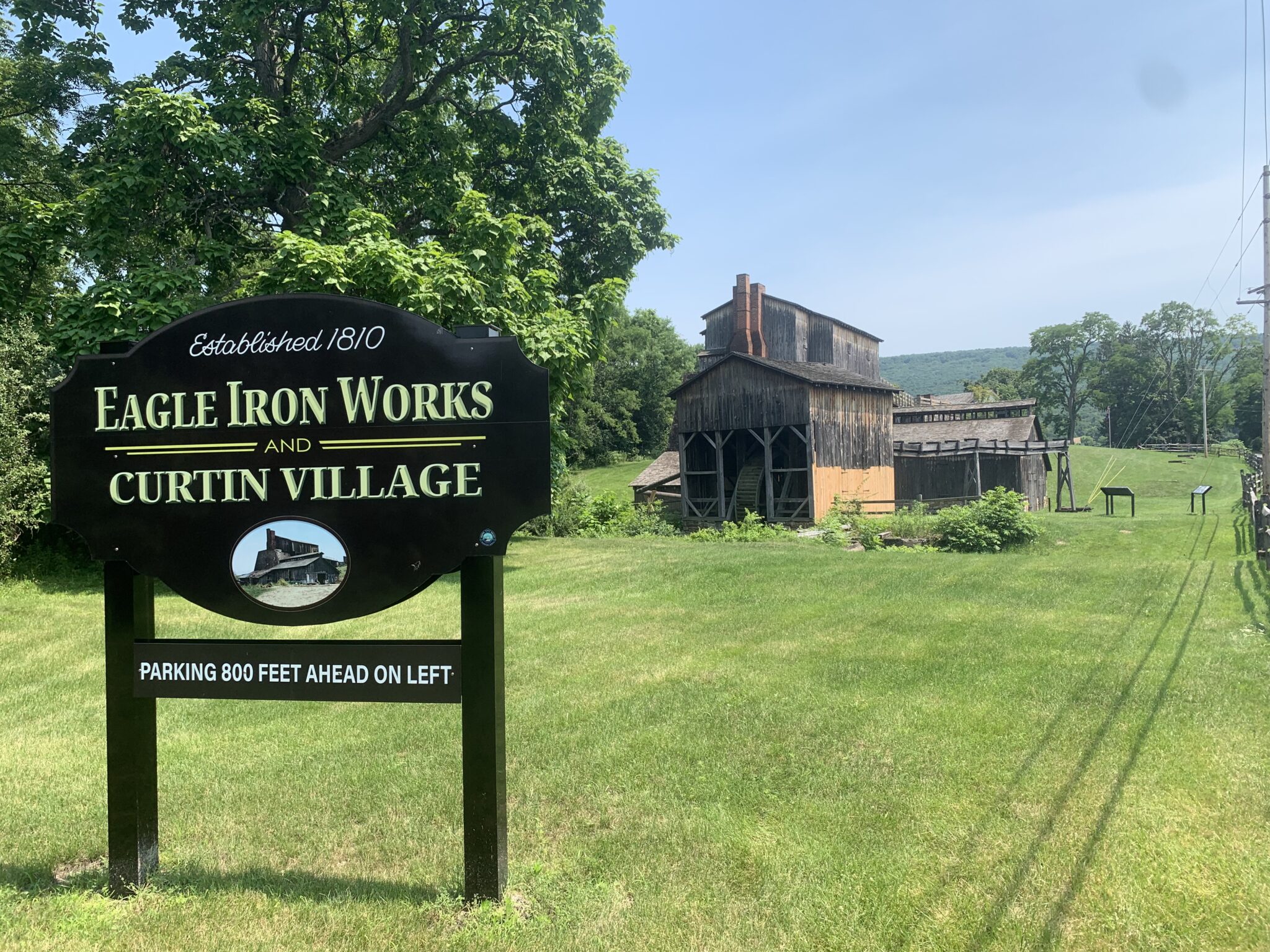
Eagle Iron Works and Curtin Village is owned and operated by the Roland Curtin Foundation, (Centre County Historical Society)
During the early 1830s, Eagle Iron Works employed as many as two hundred full and part-time workers, including charcoal makers, miners, ironworkers, craftsmen, drivers, and sundry workers. Over time, Curtin built a village that included the family mansion, worker housing, a gristmill, a company store, and a school.
By 1863, the Bald Eagle Valley Railroad was completed to Curtin Village and a station built to load iron onto trains. Nearby, the Curtin family built a two-story store, the Eagle Emporium. However, the iron industry increasingly was shifting to cheaper coal to power furnaces.
By the end of the 1800s, the charcoal-iron industry was in its final throes. During World War I, there was a brief boom for iron, but in 1921 a fire destroyed the blast furnace. When the Curtins closed Eagle Iron Works in 1922, it was the last charcoal-iron operation in Pennsylvania.
The Curtin family continued to own the property that included the mansion, as well as the furnace stack, grist mill ruins, and homes in the workers village. In the 1960s, the family donated the property to the Pennsylvania Historic and Museum Commission (PHMC) for operation as a historic site. Around the same time, the Roland Curtin Foundation was created to maintain the property and give tours.
Eagle Iron Works and Curtin Village was added to the National Register of Historic Places in 1971. However, in the early 1980s, state budget cuts forced the PHMC to consider transferring many historic sites out of state ownership. At the time, the state owned and managed fifty-seven properties.
In 2019, the PHMC announced that it would seek new owners for Eagle Iron Works and Curtin Village. The Curtin Foundation board initially opposed the move but learned that owning the site would allow the foundation to apply for grants previously unavailable. The PHMC officially transferred the property to the foundation in 2026.
In addition to offering tours of the mansion, furnace and grounds, the Curtin Foundation hosts various events each year, including Heritage Days, Apple Fest, and Christmas at Curtin. It also works with the Bellefonte Historical Railroad to offer train rides to the site.
Sources
Curtin Village and Eagle Iron Works, National Register of Historic Places, 1971.
Eagle Iron Works and Curtin Village, www.curtinvillage.com (Accessed July 13, 2026).
View sourceMcWilliams, Cecile. “Historic Centre County site ‘coming back to the community,’” Centre Daily Times, June 25, 2026.