

Article
Bellefonte
Bellefonte is the seat of Centre County’s government and one of its oldest municipalities. The borough is no longer the population center of the county but still preserves much of its rich history.
Published
Last Updated
Bellefonte is the seat of Centre County’s government and one of its oldest municipalities. The borough is no longer the population center of the county but still preserves much of its rich history.
The first recorded white settlers in what is now Bellefonte were William and Jane Ann Lamb. William Lamb acquired two adjoining tracts on either side of Spring Creek in 1776 and settled on the tract on the west side of the creek. The Lambs lived there about two years before William sold the tract and the couple moved to the Juniata Valley. He retained his right to the tract on the east side of Spring Creek, which included the Big Spring. William and his second wife Susanna returned in 1787 and settled in the northern end of the Big Spring tract.
On the southern portion of the tract, Col. James Dunlop and his son-in-law James Harris laid out the town of Bellefonte in 1795. Dunlop had served in the Continental Army and Harris, his son-in-law, was a surveyor. Like others, Dunlop and Harris were attracted by Bellefonte’s location near a supply of water at the Big Spring and the high-quality iron ore that had been discovered nearby. The same year the village was laid out, Dunlop opened Bellefonte Forge and, together with the owners of Centre Furnace, later opened Harmony Forge nearby.
Despite the hilly terrain, Bellefonte’s streets were organized in the grid scheme popular at the time. A “diamond,” or public square, was central in the design. Whether the name Bellefonte (French for “beautiful spring”) derives from the Big Spring or Dunlop’s Bellefonte Forge is the subject of dispute.
Dunlop built the first home at the corner of High and Spring streets. The first public building was a jail built on East High Street in 1800. Early businesses were the same as those found in most small towns of the era. They included general stores, blacksmiths, taverns, saddlers, tailors, shoemakers, gunsmiths, druggists, and wagon makers.
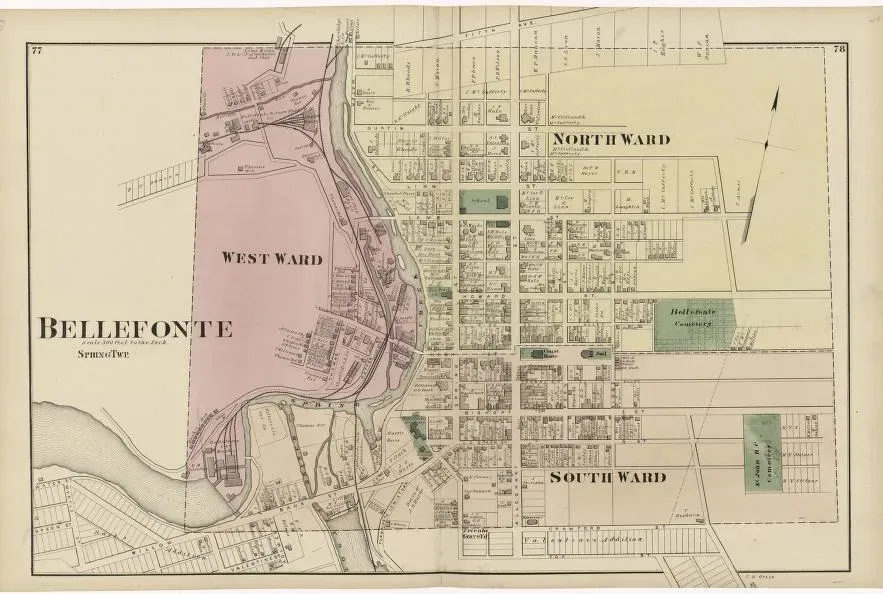
Bellefonte's streets were laid out in the grid scheme popular at the time. (Centre County Historical Society)
In 1800, Centre County was carved out of Union County. Bellefonte’s location near the entrance to the fertile Nittany Valley made it the logical choice to be the county seat. In 1806, Bellefonte was incorporated as a borough and by the end of the decade it had a population of 303. A county courthouse was built as a simple rectangular two-story structure and later was expanded with two wings.
Bellefonte’s large limestone spring had always been one of its most attractive features. The Big Spring, as it known, discharges about 15 million gallons of water a day and is consistent regardless of the weather or time of year. Wooden water pipes were laid in the early 1800s and connected to nearby homes, eventually replaced with iron pipes.
Bellefonte’s early leaders believed the town needed an academy if it was to achieve the status they desired. Land was set aside for a private school on a bluff overlooking the town and in 1805 the Bellefonte Academy opened. Many of Centre County’s early leaders attended the school. In 1834, Pennsylvania adopted the Common School System, and the following year Bellefonte joined other communities in opening public schools.
Churches were organized in Bellefonte soon after its founding. The First Presbyterian Church, whose members included many of the town’s founders, met in private homes until its first building was erected on North Spring Street in 1819. The first Trinity United Methodist Church was built on High Street in 1822. St. John the Evangelist Catholic Church was established in 1828, and its first church building opened three years later.
Bellefonte always had the largest numbers of free Black residents in Centre County. Although some early settlers and ironmasters owned slaves, by the 1830s the town had developed a growing anti-slavery tradition. The Zion African Methodist Episcopal Church was organized in 1836, followed eight years later by the Bellefonte African Methodist Episcopal Church. In 1848, the churches consolidated as the African Methodist Episcopal Church of Bellefonte. By 1860, the number of Black residents had grown to 132.
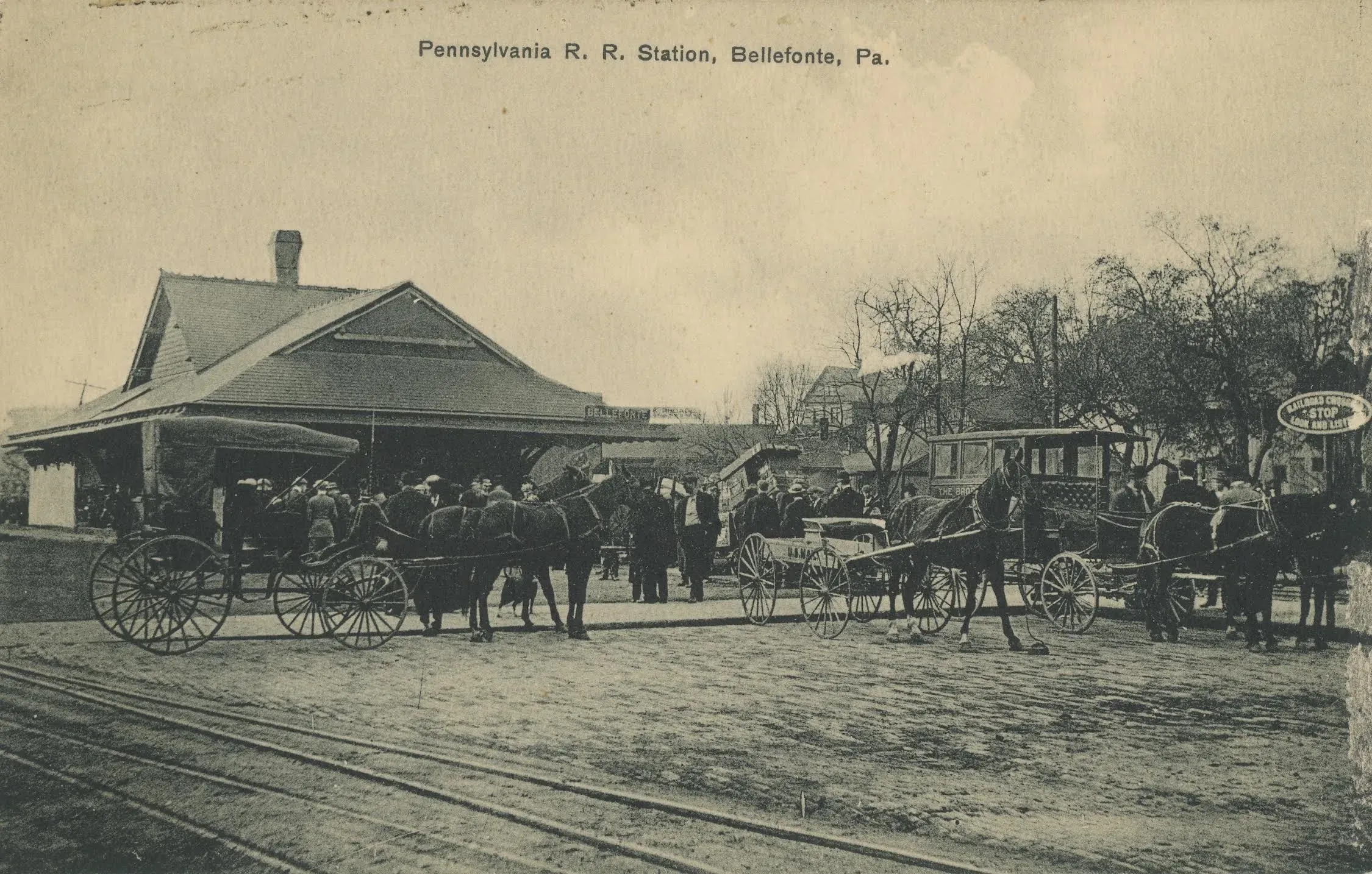
The Pennsylvania Railroad opened a new passenger station downtown in 1889. (Joan Brower Collection)
By 1826, more than ten furnaces and forges operated within a fifteen-mile radius of Bellefonte. The area’s iron ore and all the resources for processing it – timber for fuel, limestone for smelting, and streams for power – were attractive to many. As a result, Bellefonte grew steadily and attained a level of wealth greater than most towns in central Pennsylvania.
The economy of Bellefonte suffered a setback in the 1840s when the local iron industry declined. However, the discovery of coal deposits in 1857 in the Mountaintop region signaled the revitalization of iron production.
The railroad came to Bellefonte in 1859 with the creation of the Bellefonte & Snow Shoe Railroad to access coal deposits in the Mountaintop region. Later the Pennsylvania Railroad linked Bellefonte to its vast rail network via two subsidiary lines, the Bald Eagle Valley Railroad and the Lewisburg and Tyrone Railroad. The Pennsylvania Railroad opened a new passenger station in 1889, which was used widely for the next three decades. Local hotels met guests with horse-drawn carriages when they arrived.
The borough gained stature in 1860 with the election of Bellefonte native Andrew Gregg Curtin, son of local ironmaster Roland Curtin, as governor of Pennsylvania. Curtin, who had practiced law in Bellefonte, was known as the “Soldiers Friend” because of his interest in the troops in the field during the Civil War and he was re-elected in 1863. He is honored with a statue that is part of the Soldiers and Sailors Memorial in front of the courthouse.
Between 1860 and 1880, Bellefonte’s population doubled. New, strictly residential neighborhoods grew beyond downtown. Large stylish homes, many in the popular Victorian style, were built along North Allegheny, Linn, and Curtin streets, including the W. F. Reynolds home, built for the prominent banker, and the John Ardell home, built for the lumber baron.
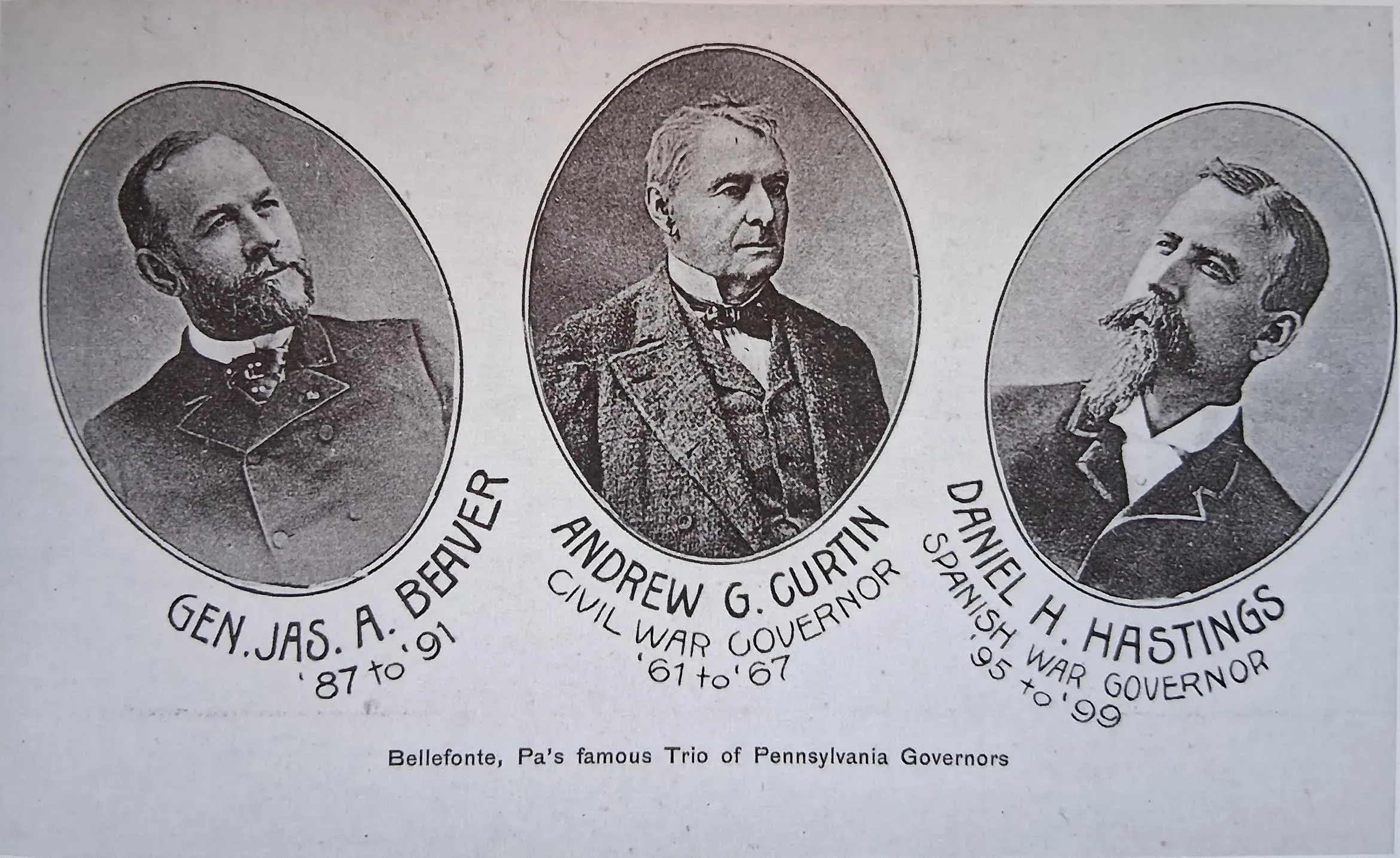
Bellefonte residents took pride in being the home of three Pennsylvania governors. (Joan Brower Collection)
The prosperity continued with the election of another Bellefonte resident, Republican James A. Beaver, as governor in 1886. Beaver was an attorney who fought in the Civil War and lost a leg. Eight years later, Daniel H. Hastings, who moved to Bellefonte to become principal of the academy and later became an attorney, won the state’s highest office.
During these decades, the downtown grew rapidly. In 1864, Henry Brockerhoff built the Brockerhoff House on the original site of the Pennsylvania Hotel. Five years later, Daniel Bush opened the Bush House along Spring Creek. The Garman Opera House debuted in 1888 on South Allegheny Street, and the following year the First National Bank opened on the square. Among the other new buildings constructed downtown were the Bush Arcade, Crider’s Exchange, Temple Court Building, and Petrikin Hall.
Many were designed by Robert Cole, a self-trained architect from nearby Houserville. Cole, who was a carpenter by trade, watched the construction boom locally and learned to design commercial and residential structures. Other local buildings were designed by Anna Wagner Keichline, a 1906 graduate of Bellefonte High School and the first woman architect in Pennsylvania. Her projects included the Plaza Theater and the Cadillac Garage and Apartments.
Bellefonte became one of the first communities in central Pennsylvania to get electricity when local leaders raised the funds to secure rights to use the new light bulb invented by Thomas Edison. The Edison Electric Illuminating Co. was chartered, and a power station was built at the corner of North Water and West Lamb streets. In early 1884 electric lighting was run to several downtown businesses and over the next decade more business and homes became illuminated.
The Bellefonte Central Railroad was incorporated in 1892 to haul lime and limestone from nearby quarries. It also made daily passenger round trips to State College, providing an important transportation link for the growing college town. The Bellefonte Central established Hunter’s Park, a picnic and outdoor recreation site west of the borough. The railroad operated weekend shuttles to the park from Bellefonte during the warm months.
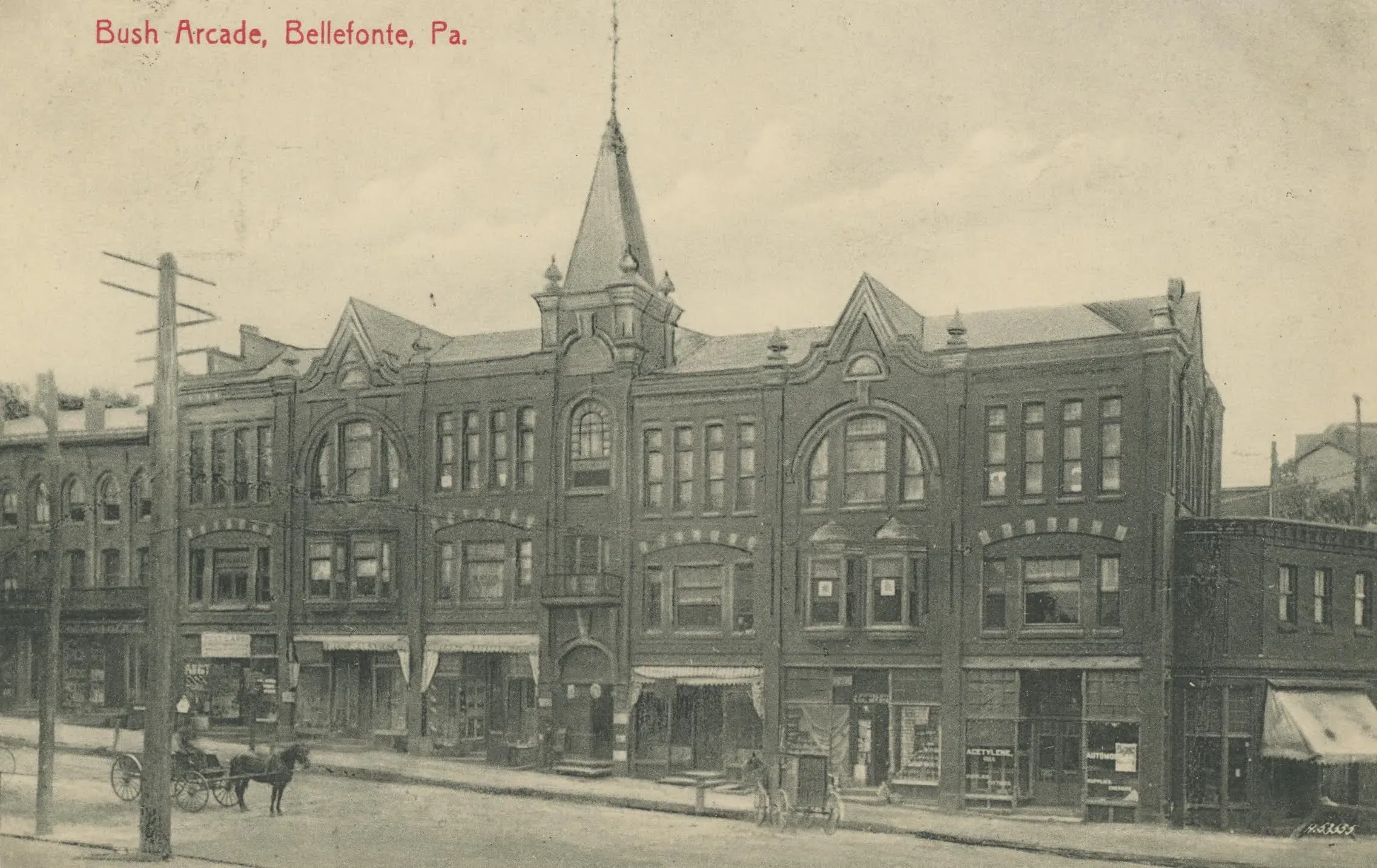
The Bush Arcade was one of several notable buildings constructed downtown in the late 1800s. (Joan Brower Collection)
Mills had operated in Bellefonte since its founding. In the decades after the Civil War they were joined by heavy manufacturing, including the Bellefonte Glass Works, Bellefonte Car Works, and Bellefonte Nail Works. The Pennsylvania Match Company, founded in 1899, grew to become one of the largest match producers in the United States.
By 1890, Bellefonte had a population of 7,136. However, the emergence of the Pittsburgh steel industry and the subsequent closing of several nearby ironworks dealt a blow to the economy. The borough began losing population in the early 1900s. The Bellefonte Academy closed in 1933. Passenger train service ended in 1950. Various business also left the downtown.
A bright spot was Titan Metal Co., founded in 1925 and a major employer of Bellefonte residents for decades. The company was a worldwide producer of brass rods and casings. During the 1940s and 1950s, Titan played a significant role in community affairs before being sold and eventually closing in 2008.
By the 1960s, numerous buildings on High Street and Spring Creek were no longer used and had fallen into disrepair. Planning and site development for a creekside park took a decade and financial problems nearly doomed the project. However, a citizens group stepped in to raise the money needed to finish construction of Talleyrand Park. Since that time, it has been expanded and new features added.
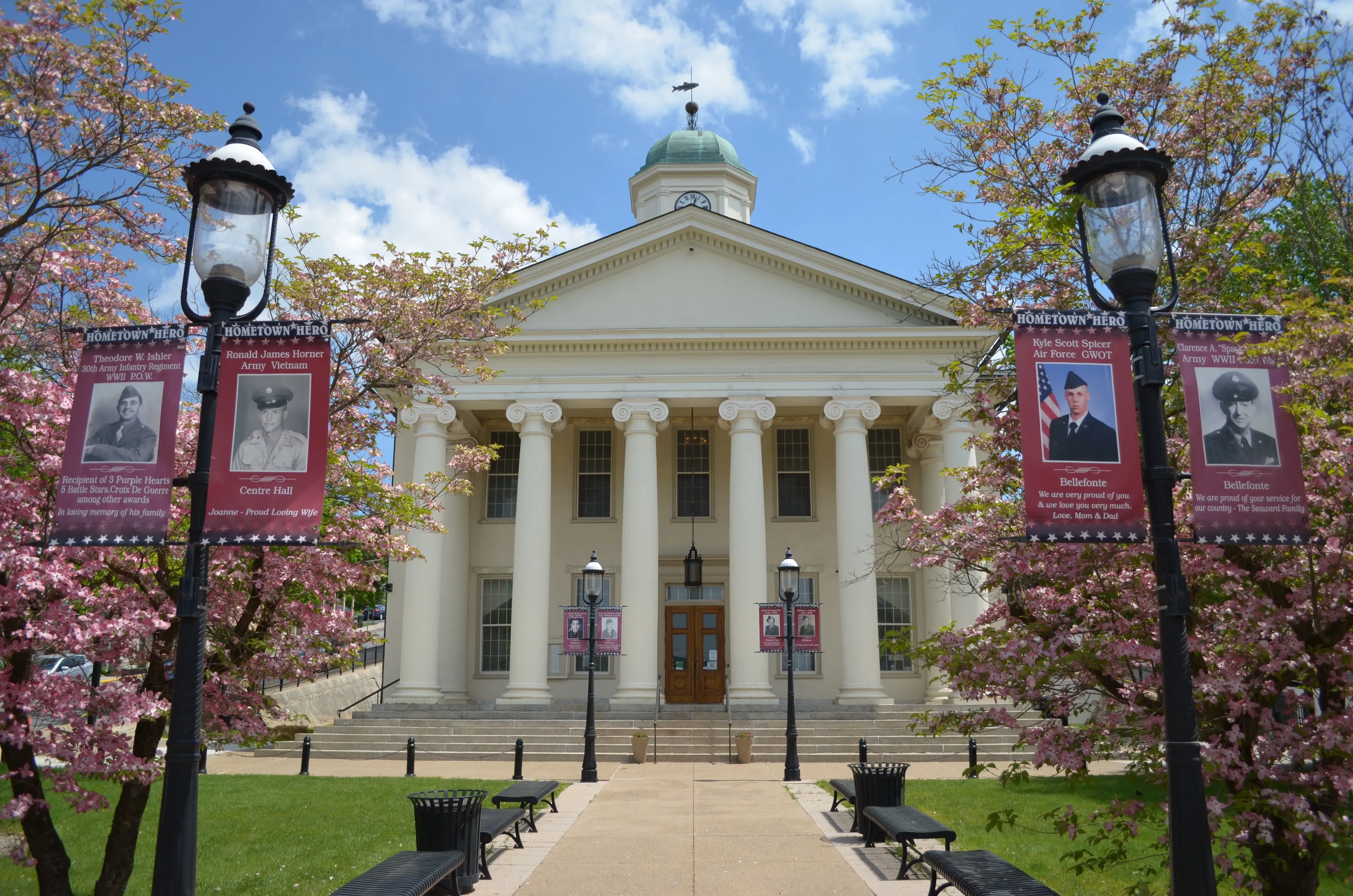
The Centre County Courthouse remains one of the county's most historic landmarks. (Centre County Historical Society)
By the late 20th century, Bellefonte had largely become a bedroom community for State College and Penn State. The Bellefonte Historic District was added to the National Trust for Historic Preservation in 1977 and lists more than 350 properties. Since that time, preservation efforts have saved numerous commercial and residential structures for new uses.
The American Philatelic Society purchased the Pennsylvania Match Factory in 2002 for its headquarters. The Centre County government acquired the Reynolds Bank building in 2004 and renovated it for a courthouse annex. The Bellefonte Art Museum opened in the Linn House in 2008. Several bed-and-breakfast inns also have opened in Victorian-era homes. However, fires have destroyed several notable downtown buildings, including the Bellefonte Academy in 2004 and the Bush House in 2006.
Today Bellefonte is the home of several popular Centre County events, including the Bellefonte Victorian Christmas and Historic Bellefonte Cruise. The Bellefonte Historical Railroad offers seasonal rides for residents and tourists interested in scenic railroading. As of the 2020 census, the borough had a population of 6,105.
Author
Ford Risley
Sources
Bellefonte Historic District, National Trust for Historic Preservation, 1977.
Ebenezer: Brief Histories of Bellefonte’s Still-Active 19th Century Congregations, 2016.
Historic Buildings of Centre County Pennsylvania. The Historic Registration Project of Centre County Library. Gregory Ramsey, Coordinator. University Park: Keystone Books, 1980.
Lewis, Pierce F. “Small Town in Pennsylvania,” Annals of the Association of American Geographers. Vol. 68, No. 2 (June 1972), pp. 323-351.
Linn, John Blair. History of Centre and Clinton Counties, Pennsylvania. Philadelphia: L. H. Everts, 1883.